
Your MOT test is booked and the date is coming up fast. The last thing you want is a call from the garage telling you the car has failed on something you could have caught yourself. Tyres are one of the most common reasons vehicles fail their MOT in the UK, and the good news is that most problems are visible before the test even happens. A quick check in your driveway could save you a retest fee and an unexpected repair bill.
Why Tyres Are One of the Most Common MOT Failure Points
MOT examiners inspect every tyre in detail, looking at tread depth, sidewall condition, tyre age, pressure, and whether tyres are correctly matched on each axle. Because tyres are the only contact point between your car and the road, any concern gets taken seriously. Drivers covering the roads around Aldershot, Farnborough, Ash Vale, and North Camp deal with a real mix of road surfaces throughout the year, and that puts steady wear on tyres that can creep up unnoticed.
The encouraging thing is that none of these checks require specialist tools or mechanical knowledge. Knowing what to look for puts you well ahead before test day.
1. Tread Depth Below the Legal Limit
Tread depth is the most common tyre-related MOT failure, and it catches more drivers out than any other issue. The legal minimum in the UK is 1.6mm across the central three-quarters of the tyre. Below that, the tyre loses its ability to channel water away from the road effectively, which is a serious safety concern especially on the wet roads around Farnham, Fleet, and Tongham during autumn and winter months.
The good news is that checking your tread takes less than a minute.
How to check at home:
- Place a 20p coin into the main tread groove
- If the outer rim of the coin is visible, your tread is likely below the legal limit
- Check in at least three places across the tyre, including the centre and both edges
- Uneven readings across the tyre can point to a separate alignment or pressure issue
Many tyre specialists recommend replacing tyres at 3mm rather than waiting for the legal minimum. Stopping distances increase significantly on wet roads once tread drops below that point, particularly at higher speeds on dual carriageways.
2. Tyre Sidewall Damage: Bulges, Cuts and Cracks
Sidewall damage is treated as one of the most serious tyre defects on the MOT test. Unlike tread wear, which develops gradually, sidewall damage can appear after a single incident — a sharp kerb, a pothole, or a slow scrape that seemed minor at the time. Roads around Ash, Tongham, and parts of Aldershot town centre have their fair share of kerbs and uneven surfaces that can catch a tyre at the wrong angle.
What to look for:
Bulges: appear as a visible lump pushing outward from the sidewall. They indicate that the internal structure of the tyre has been compromised and the tyre could fail without warning. Any bulge, regardless of size, is classed as a dangerous defect and will result in an automatic MOT failure.
Cuts and splits: on the sidewall are flagged if they expose the cords or ply beneath the rubber surface. Even a cut that looks superficial on the outside can run deeper than it appears.
Cracking: develops over time as rubber ages and dries out. Fine surface cracks may not fail the MOT immediately, but deep or widespread cracking is a concern that examiners will act on.
Run your hand slowly around the full sidewall of each tyre in good light. It takes two minutes and it is the kind of check that can prevent a dangerous blowout as much as an MOT failure.
3. Incorrect Tyre Pressure and What It Actually Affects
Tyre pressure does not have its own dedicated MOT pass or fail box, but it has a direct effect on several things that do get tested. Running on the wrong pressure causes uneven tread wear, which can push depth below the legal limit in specific areas of the tyre. It also affects how the tyre sits on the rim, which can flag concerns around structural integrity during the inspection.
Does tyre pressure directly fail an MOT?
Not as a standalone item, but the damage it causes over time absolutely can. A tyre that has been consistently under-inflated will show heavy wear along both outer edges. Over-inflation causes wear concentrated in the centre. Either pattern can result in tread depth readings that fall below 1.6mm in those worn areas, which is a failure.
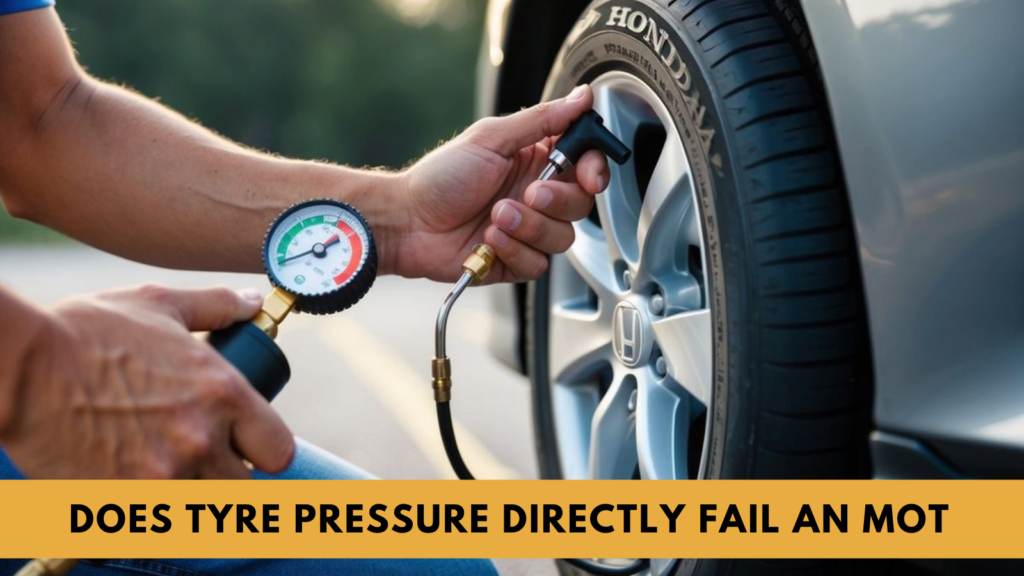
Checking pressure is straightforward and free at most local forecourts across Farnborough, Aldershot, and Fleet. The correct pressure for your vehicle is listed inside the driver’s door frame or in the owner’s manual. Always check pressure when the tyres are cold, as driving heats the air inside and gives a higher reading than the true resting pressure.
A quick pressure check once a month takes minutes and protects both your tyres and your MOT result.
4. Mismatched Tyres on the Same Axle
This is the MOT failure that surprises drivers most, largely because it is not something many people think to check. The rule is straightforward, tyres on the same axle must be of the same construction type. Mixing a radial tyre with a cross-ply tyre on the same axle is an automatic failure, regardless of how much tread either tyre has remaining.
Beyond construction type, significant differences in size or speed rating across the same axle can also raise concerns during the inspection. It is an area where a well-intentioned part-replacement, fitting one new tyre without checking what is already on the other side, can create a problem that was not there before.
How to check if your tyres match:
- Look at the sidewall of each tyre on the same axle
- The size is printed as a number sequence, for example 205/55 R16
- The speed rating appears as a letter at the end of that sequence
- Both tyres on the same axle should show identical markings
- If the construction type is not clear, a tyre specialist can confirm it in seconds
Drivers across Ash Vale, North Camp, and surrounding areas who have had a single tyre replaced in the past year are worth double-checking this one. It is a simple look that takes no time at all.
5. Tyre Age and Rubber Degradation
This is the tyre problem that catches the most drivers off guard, because a tyre can look perfectly fine on the outside and still be unsafe. Rubber degrades over time regardless of how much tread remains. As it ages, it loses flexibility, becomes brittle, and develops small cracks that weaken the overall structure, even if the tyre has never been driven hard.
Most tyre specialists consider tyres over ten years old to be a safety concern, and MOT examiners are trained to assess overall tyre condition as part of the inspection.
How to find your tyre’s age
Every tyre has a four-digit DOT code moulded into the sidewall. The first two digits represent the week of manufacture and the last two represent the year. So a code reading 2419 means the tyre was made in the 24th week of 2019.
It is worth checking this on all four tyres, particularly on lower-mileage vehicles. A car that sits on a driveway in Farnham or Fleet for long periods between journeys can age its tyres faster than one driven regularly, because UV exposure and inactivity both accelerate rubber degradation.
Tread depth can look reassuring right up until the point an aged tyre is flagged during inspection. Checking the date takes thirty seconds and gives you a clear picture of what you are working with ahead of your MOT.
How to Check Your Tyres Before an MOT
Pulling all of this together into one simple routine makes the whole process far less daunting. You do not need a mechanic’s knowledge or any specialist equipment, just good light, a 20p coin, and around ten minutes. Drivers across Aldershot, Farnborough, Ash, and the surrounding areas can do this check at home before booking their MOT with confidence.
Work through each tyre in this order:
- Tread depth: insert a 20p coin into the main grooves in three different spots across the tyre. The outer band of the coin should not be visible.
- Sidewall condition: run your hand and eyes around the full sidewall looking for bulges, cuts, cracks, or any deformation.
- Tyre pressure: check against the manufacturer’s recommended figure when the tyres are cold.
- Tyre age: locate the four-digit DOT code on the sidewall and confirm no tyre is over ten years old.
- Axle matching: compare the size and speed rating printed on both tyres of each axle to confirm they match.
If anything looks uncertain during this check, getting a professional eye on it before the MOT is always the smarter move. Catching a problem a week before your test gives you time and options. Catching it on test day does not.
Get Your Tyres Checked Before Your MOT
Tyre problems rarely announce themselves, they develop quietly over months of everyday driving and only become obvious when someone takes a proper look. The five issues covered in this article account for a significant proportion of MOT tyre failures, and every single one of them can be identified before your test date with a straightforward check at home.
If anything during your own inspection leaves you uncertain, or if your MOT is coming up and you simply want peace of mind, a professional tyre check is the sensible next step. Drivers across Aldershot, Farnborough, Ash Vale, Farnham, Tongham, North Camp, and Fleet trust G Force Tyres for honest, straightforward advice and a thorough look at their tyres before test day.
Book your MOT test or a pre-check with our tyre specialists and arrive with complete confidence.
FAQs: Tyres and MOT Failure
Will a tyre bulge fail an MOT? Yes, without exception. A bulge on the sidewall indicates internal structural damage and is classed as a dangerous defect. The vehicle will fail its MOT and should not be driven until the tyre is replaced.
What tread depth fails an MOT in the UK? Any tread depth below 1.6mm across the central three-quarters of the tyre will result in a failure. Many specialists recommend replacing tyres at 3mm to maintain safe stopping distances, particularly in wet conditions.
Can mismatched tyres cause an MOT failure? Yes. Tyres of different construction types on the same axle are an automatic failure. Significant differences in size or speed rating across the same axle can also be flagged during inspection.
How old can tyres be before failing an MOT? There is no fixed age limit written into MOT rules, but examiners assess overall tyre condition and tyres over ten years old are widely considered unsafe due to rubber degradation, regardless of remaining tread depth.
Can I check my tyres myself before the test? Absolutely. A basic check covering tread depth, sidewall condition, pressure, age, and axle matching can be done at home in under ten minutes with no specialist tools required.
Does tyre pressure affect my MOT result? Not directly, but incorrect pressure causes uneven wear over time that can push tread depth below the legal limit in certain areas of the tyre, which will result in a failure.